








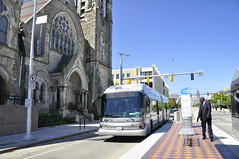
 Cleveland’s Health Line, America’s highest-scoring BRT. Photo from EMBARQ Brasil on flickr. |
When new bus rapid transit lines are discussed, proponents often say they hope to make the routes gold standard, meaning so high quality that they mimic many features of rail. That’s a high bar; most BRT projects in the United States don’t even qualify as true BRT, and so far not one has actually met the gold standard.
The Institute for Transportation & Development Policy publishes BRT standards that describe minimum characteristics necessary for a bus route to qualify as BRT. Those standards establish three levels of BRT quality: bronze, silver, and gold. They include features like off-bus fare collection, high station platforms, and bus frequency.
So far, only 5 lines in the United States have scored highly enough to qualify as true BRT, and all 5 rank at the bronze level. Not one is even silver, let alone gold.
According to ITDP, the best performing BRT systems in the world are Bogota, Colombia and Guangzhou, China, which score 93/100 and 89/100, respectively. They are the gold standard.
By comparison, the United States’ highest-scoring BRT route is Cleveland’s Health Line, which hits bronze with a score of 63. The other 4 bronze BRT lines in there US are in Eugene, Los Angeles, Pittsburgh, and Las Vegas.
Boston’s famous Silver Line, which even runs in a subway for a short stretch, scores a meager 37. That’s not enough to qualify as true BRT at all, even a low level.
It isn’t that gold standard BRT is impossible in the United States. Certainly it’s possible. But it isn’t built here because nobody really wants to build it.
The same community leaders who choose BRT over rail because BRT is cheaper then make the same choice when faced with other potential cost-cutting measures. They eliminate the most expensive features, until the gold standard that was promised isn’t actually what’s delivered.
That sort of feature cutting is called BRT creep, and so far it’s happened to some extent on every major BRT project in American history.
None of this should suggest that BRT is worthless. Sometimes BRT creep can even be beneficial, if it makes an otherwise infeasible project possible. Bronze level BRT is still rapid transit, after all, and even bus priority routes that don’t fully qualify as actual BRT are often a huge improvement over regular busing.
WMATA’s MetroExtra service, for example, isn’t usually called BRT even by low American standards, but it’s still a great service. It was something Metro could do quickly and cheaply to help riders, and it works.
But beware the politician who argues for gold standard BRT over rail. Odds are they won’t deliver.
 Cross-posted at Greater Greater Washington.
January 17th, 2013 | Permalink
Tags: BRT, transportation



